A client-led product, and my part in it.
Picsume is a white-label recruitment SaaS platform for employers with many locations: each branch runs its own hiring, separately, under one main company. I worked directly with the client, translating detailed business requirements into user flows, interfaces and reusable design patterns.
Beyond executing the brief, I proactively identified edge cases, questioned assumptions and explored alternative scenarios. These discussions sometimes led to changes in user flows and information architecture, helping make the product more coherent and robust.
Over the engagement the product raised a multimillion-dollar funding round and moved from candidate search to an enterprise applicant tracking system (ATS). When a white-label spin-off was added, I designed it from scratch, and while that work was underway the stakeholders decided to make the white-label product Picsume’s primary selling point.
In the white-label version, a company like a large restaurant chain gets its own dedicated, branded job board. Each location runs its hiring separately underneath the main company, and the board never mixes with other companies’ jobs.
- Business requirements and priorities
- Detailed briefs for each product area
- The main business decisions
- Turning requirements into user flows and interface structures
- Interfaces and reusable design patterns
- Raising edge cases, missing scenarios and architectural issues
- Design QA and HTML/CSS-aware handoff
- White-label, multi-branch recruitment SaaS
- White-label product designed from scratch
- Direct collaboration with the client
- Detailed business briefs and requirements
- Complex workflows across several product areas
- Reusable component library and design system
- Edge cases, interaction logic and information architecture
“Great work so far on the locations and job views. Exactly what we’re looking for. … Olga, always helping us through the details. Thorough and thoughtful approach. You make my job easy.”
Many workflows, many branches, one coherent product.
Executing the brief, and asking what it didn’t cover.
- Translated requirements into user flows and interface structures
- Identified missing scenarios and potential edge cases
- Asked “what if?” questions to uncover gaps in the proposed experience
- Explored alternative flows and discussed their implications with the client
- Collaborated on revising workflows and information architecture when needed
- Kept interfaces and reusable components consistent
“What happens if this scenario occurs?”
“What if the user takes a different path?”
“How can we handle this without creating a confusing experience?”
Some of these led to collaborative discussions with the client, revised user flows and changes to the product architecture. Business decisions stayed with the client.The breadth of the product.
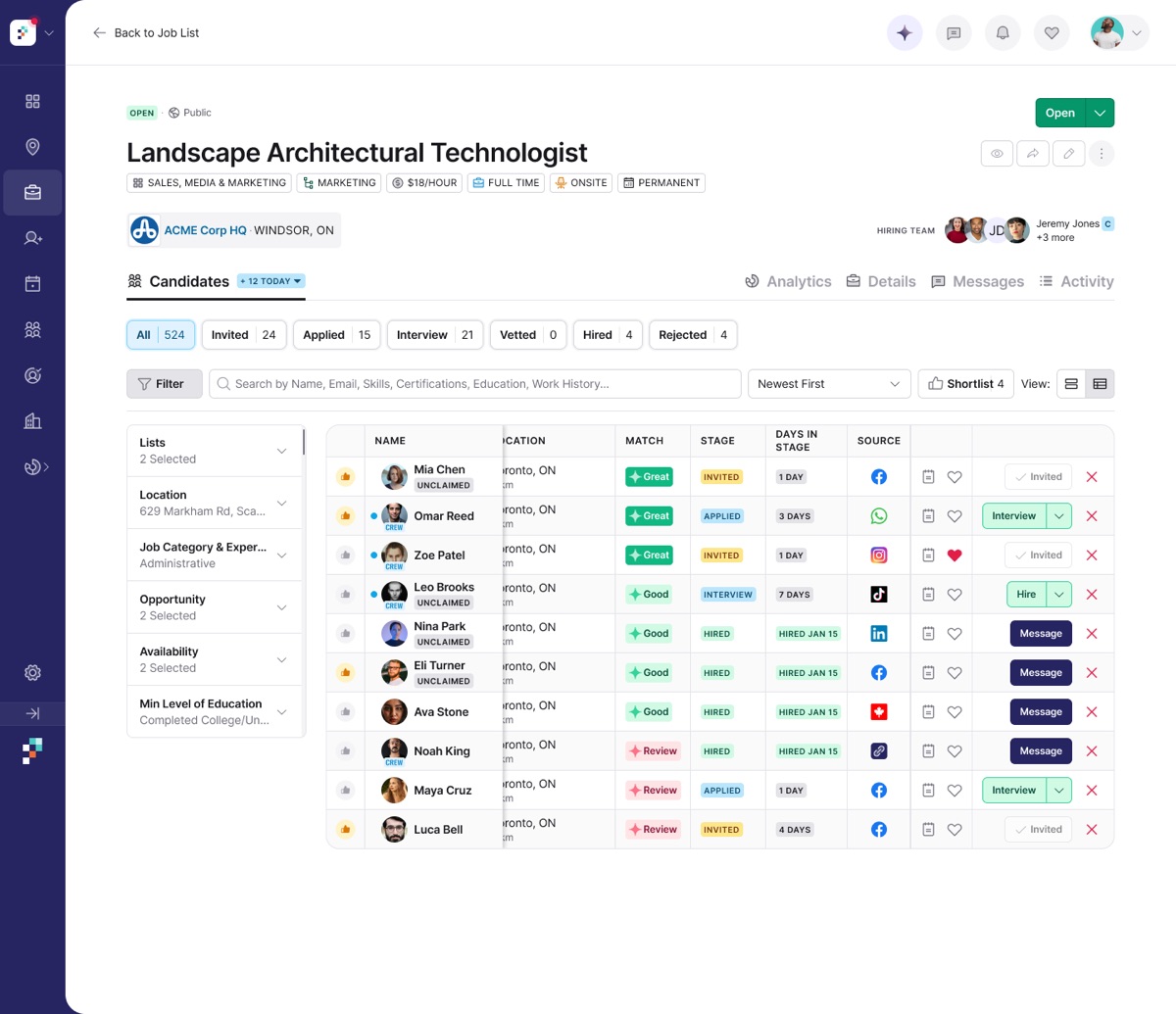
Recruiter workflows, the candidate side and white-label reports. Hover a screen for details; click to see it full size.
2,000+ components behind one consistent product.
I built and maintained a library of 2,000+ components and variants with toggleable states, working in Figma and Subframe (AI-assisted design). Reusing these components and patterns kept new features consistent across product areas and white-label versions, and made handoff predictable.
What was delivered.
- The white-label product, designed from scratch and later made the primary selling point
- ATS candidate pipeline for recruiters
- Job analytics view (designed and built, not shipped)
- Candidate and employment reports in a white-label theme
- Candidate profiles, job search and matching
- White-label and universal job board versions
- Mobile screens for candidates
- A library of 2,000+ components and variants with toggleable states
- Design QA across builds
- Handoff to developers with HTML/CSS fluency
- Design support through a multimillion-dollar funding round and the move from candidate search to an enterprise ATS
Working on Picsume strengthened my ability to translate complex business requirements into structured, usable interfaces. It also reinforced the value of looking beyond the initial brief, identifying edge cases early, and collaborating with clients to make workflows more complete and consistent.